Gantt timeline
The Gantt view is the same backlog as the Kanban, arranged along time instead of by state. A NOW line splits the stage into a PAST zone (finished work, oldest on the left) and a FUTURE zone (todo and doing, leftmost is up next).
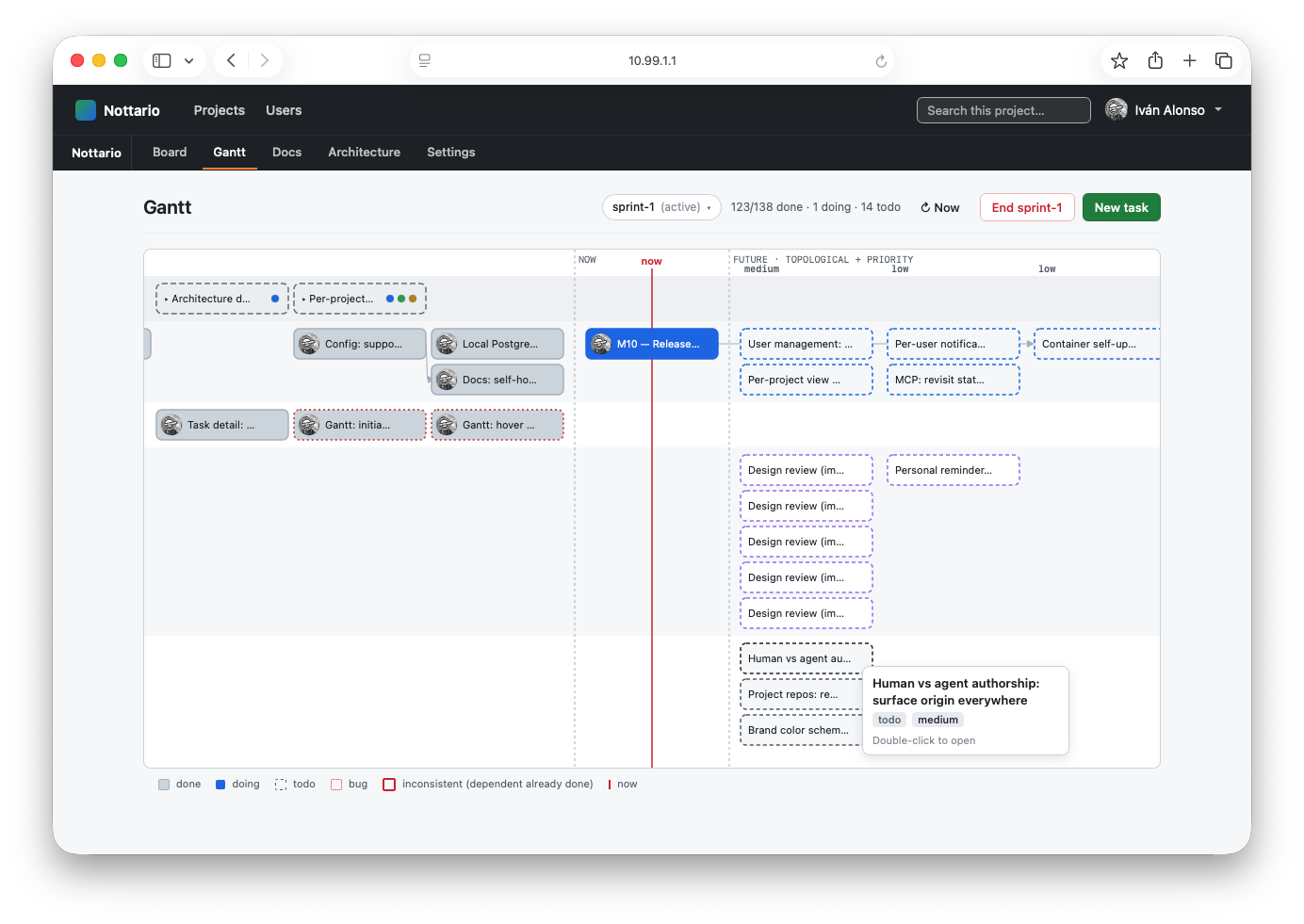
How it lays out
Bars are coloured by state, sized by the task's duration when known
(actual start → actual end for past work; eligibility window for
future). Within each role lane, tasks order topologically by
dependency first, then by priority bucket. A feature parent
collapses its children into a single grouped bar with an unfold
control.
Interaction
- Hover a bar: a card surfaces with the full title and the task's current state, dependencies and assignee.
- Click a bar: opens the detail dialog (the same dialog the Kanban uses).
- The
Nowbutton in the toolbar re-centres the NOW line if you scrolled away.
What it is good for
- Spotting the critical path: which open task is blocking the most others.
- Picking up the next eligible work without re-reading the backlog.
- Reviewing what shipped in a sprint at a glance — the PAST zone reads as a stratigraphy of done work.
The Gantt and Kanban share the same data and the same realtime channel, so edits propagate live across both.
How an agent uses the Gantt
The Gantt is a humans-only visualisation; an agent never opens it. But the layout reflects the same data the agent reaches through the MCP tasks domain, so the same lens is available programmatically:
nottario.tasks.list { project_id, cycle_id?, target_role_id? }returns the same rows the Gantt lays out — type, priority, state, dependencies, target role, actual_start, actual_end. Order them by topological depth then priority to recover the Gantt's left-to-right ordering.nottario.tasks.next { project_id, target_role_id? }is the read-only equivalent of the Gantt's "what's coming up next" — it returns the eligible todo at the head of the FUTURE zone without claiming it. Use it to plan; useclaim_nextto act.- After landing work,
nottario.tasks.link_commitandset_state donemove the bar from the FUTURE zone to the PAST zone (the actual_start / actual_end timestamps are stamped on the state transitions).
The PAST zone is a structured record of "what shipped, when": an
agent reviewing what was done in the last sprint can list
{ state: 'done', cycle_id: <past sprint> } and read the same
stratigraphy the human sees on the chart.