Kanban board
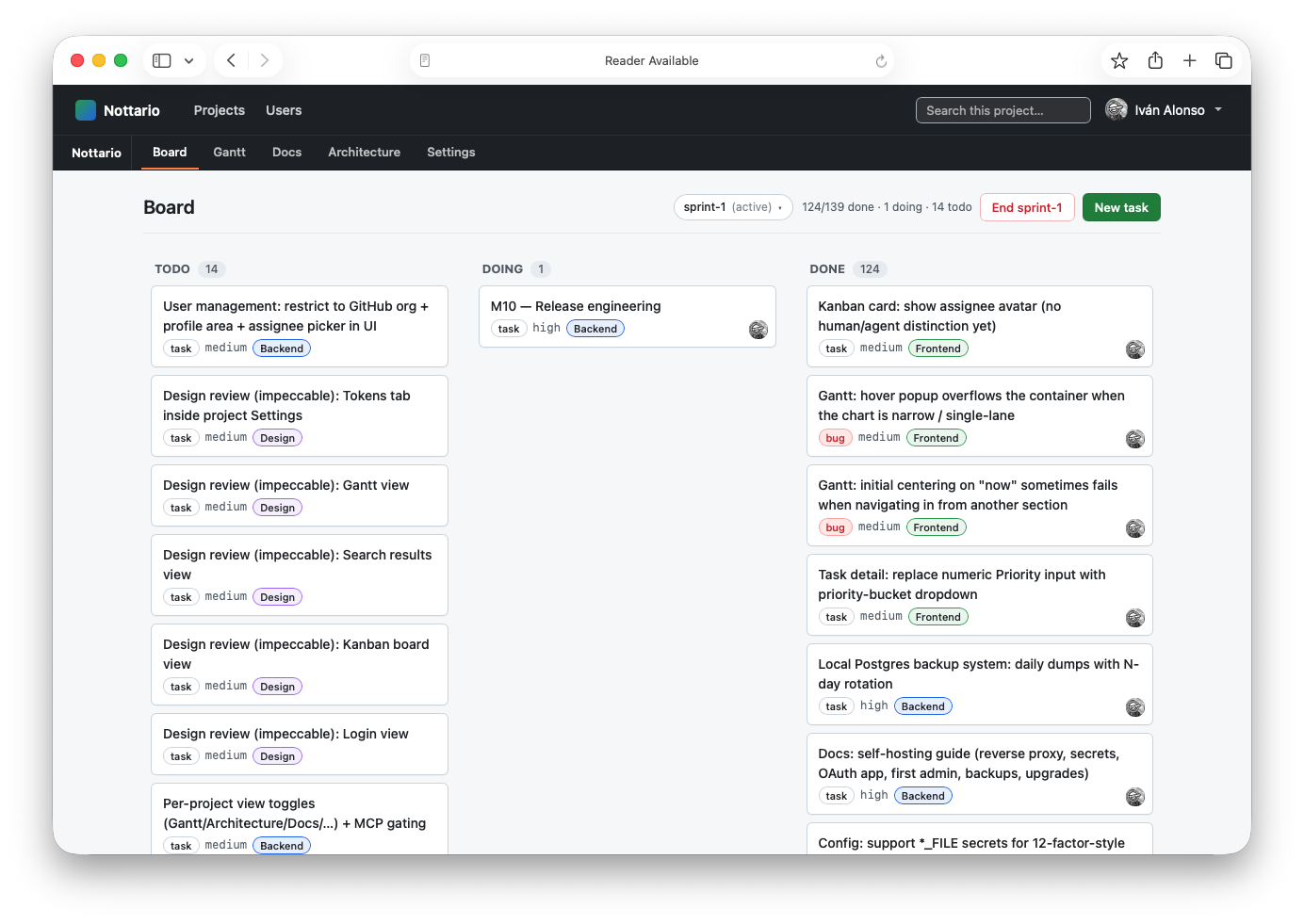
The Kanban is the primary picker for what to work on next. Three
columns — todo, doing, done — show every task in the
active cycle. Cards carry the task type (task / bug / feature),
the priority bucket and the target role. When a task is assigned,
the owner's avatar sits in the bottom-right corner so you can see at
a glance who is holding what.
Day-to-day
- A click on a card opens the detail dialog with description, dependencies, linked commits and comments.
- Steps are a task's short checklist. In the dialog, tick a step,
click its text to rename it, drag the grip (or press Alt+Up /
Alt+Down) to reorder it, and type in "Add a step" to add one; pasting
several lines adds one step per line. A card with steps shows its
progress, for example
2/8, which turns green when every step is done. A task can be closed with steps left undone. - Drag a card across columns to change its state. The same
transitions are reachable from the dialog or via
nottario.tasks.set_stateover MCP. - The "Up next" affordance surfaces the highest-priority eligible
todo when the doing column is empty, so you don't have to
scan the backlog manually. Agents reach the same row atomically
via
nottario.tasks.claim_next.
Sprints
The header shows the current cycle name and progress counters
(N done · M doing · K todo). The End sprint button at the
top right atomically closes the active cycle and rolls every open
task onto the next sprint; tasks already done stay stamped on the
sprint they shipped in.
The cycle dropdown to the left lets you view a past sprint without leaving the page; the view narrows to that sprint's snapshot.
Realtime
Both kanban and gantt are wired to LISTEN/NOTIFY over SSE: when a
human or an agent edits a task elsewhere, the card updates in
place within a second. No reload needed. Comment edits in the open
detail dialog refresh the same way.
How an agent drives the board
The kanban is the human-facing surface; the agent works the same backlog through the MCP tasks domain. A typical loop:
nottario.tasks.claim_next { project_id, target_role_id? }— atomically picks the highest-priority eligible todo and stampsstate=doing+assignee_user_id=<caller>in a single query. The card visibly moves into the doing column on every connected browser within a second.- The agent does the work, then for each commit it produced calls
nottario.tasks.link_commit { task_id, repo, sha }so the Commits panel of the detail dialog can render the diff link. nottario.tasks.add_comment { task_id, body }captures a short closing note for the human reading the row later.nottario.tasks.set_state { task_id, state: "done" }— the card moves to done, dependents become eligible, and a feature parent rolls up to done automatically when all its children are done.
Filing new work as the agent discovers it (a side bug spotted, a
follow-up task) is nottario.tasks.create with the right
target_role_id so it shows up in the right swimlane next time a
matching agent runs claim_next.